The Evolution of Multicellularity
Multicellularity evolved in two stages: first
from single cells to biofilms ("training wheels" for
multicellularity), then to true multicell organisms. All four
multicellular organizing principles have their roots in
biofilms.
As a multicellular organism grows and develops, it must organize its physical structure: its leaves, arms, stalks, roots, eyes, gills, exoskeleton or bones and, crucially, its reproductive organs. All must develop in the right place at the right time and with the right function. Such a complicated physical structure requires many different specialized cells to provide all the necessary functions. And the various specialized cells must cooperate and communicate with each other to deal with the complexities of the world in which the organism lives.
How do they manage to specialize when all the cells of a multicellular organism share the same DNA? Answer: during development from the single fertilized egg, successively more DNA is turned off or sequestered so that it doesn't participate in the cell's function. A tricky task, many details of which remain poorly understood.Biofilms
Metazoans (the formal biological name for multicellular
organisms) were not the first collections of different cells to
act in concert. Long before Metazoans appeared, there were
organized "cooperative" communities called biofilms. Biofilms
are complex
ecologies of single-cell organisms that typically
include algae, bacteria, protozoa, cyanobacteria, fungi, and
viruses. Biofilms
often
include
hundreds
of
different species of single-cell organisms that play different
roles for the benefit of all. They collectively generate
and embed themselves in an extracellular polymeric matrix that
provides structure and protection. The earliest colony
bacteria we know of were the cyanobacteria that evolved more
than three billion 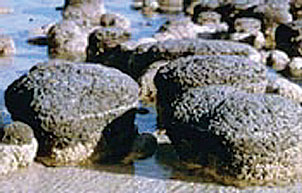 years ago. Their fossil remains
are visible today because these colonies secreted a thick
polymer gel that held them together and protected them from
strong solar radiation. The gel also trapped sand and debris
from the surf which, together with slime secreted by the
bacteria, formed the beautiful patterns of the Stromatolite
fossil reefs visible in Australia (see image at left). These
structures vary from twig-size to semi-truck size. Today we
encounter another biofilm, dental plaque, whenever we brush our
teeth. Other types of biofilm include the slippery films on
rocks in streams and on many other surfaces such as contact
lenses, artificial heart valves. plant roots, and the inside
surfaces of fresh water pipes. Present-day biofilms support
analogs of all four key principles. Although we do not know how
or when these principles arose, they must have been in place
when true multicellular organisms - plants, animals, and fungi
-- first appeared between 500 million and one billion years ago.
years ago. Their fossil remains
are visible today because these colonies secreted a thick
polymer gel that held them together and protected them from
strong solar radiation. The gel also trapped sand and debris
from the surf which, together with slime secreted by the
bacteria, formed the beautiful patterns of the Stromatolite
fossil reefs visible in Australia (see image at left). These
structures vary from twig-size to semi-truck size. Today we
encounter another biofilm, dental plaque, whenever we brush our
teeth. Other types of biofilm include the slippery films on
rocks in streams and on many other surfaces such as contact
lenses, artificial heart valves. plant roots, and the inside
surfaces of fresh water pipes. Present-day biofilms support
analogs of all four key principles. Although we do not know how
or when these principles arose, they must have been in place
when true multicellular organisms - plants, animals, and fungi
-- first appeared between 500 million and one billion years ago.
The four principles of multicellularity
The full complement of genes and DNA control sequences in a
multicellular genome is far more complex than that of most
single cell organisms [1].
Yet any given type of Metazoan cell - and there are about 250
different types in humans - is functionally simpler than a
typical single cell organism. Each differentiated cell type uses
just a subset of the 22,000 total human genes. For example, all
cells in the body have the gene for hemoglobin, but only red
blood cells make that protein. Along with this specialization, the cells must
coordinate their activities by sending messages
to each other. They work cooperatively to develop their "body,"
which is a stigmergy structure.
And they need apoptosis mechanisms
to remove cells that have outlived their usefulness or become
dangerous. Without all four of those organizing principles
operating together in a
coordinated manner, true multicellularity would not have
been possible.
The benefits of multicellularity
As a multicellular organism develops from its original cell (or in some species such as Hydra, cells that have "budded" from the parent), its genetic program directs the 'daughter' cells to sequester and permanently silence much of their DNA at predetermined stages of development, thereby becoming specialized for different functions. Some organisms have multiple stages of stable forms, e.g., insects that exhibit larva, pupae, and adult forms. But these developmental stages all involve programmed cell differentiation. For most cells, differentiation and the resulting cell specialization is dramatic and irreversible.
It is difficult to argue that any one factor is primarily responsible for the evolution of multicellularity. Conventional wisdom once asserted that the primary benefit of multicellularity, hence presumably what drove its evolution, was the division of labor, or specialization, provided by differentiated cells. (see Maynard Smith, J. & Szathmáry, E. The Major Transitions in Evolution, 1995). But preexisting biofilms already used all four principles, not just specialization. They used stigmergy to structure their colonies and polymorphic messaging for quorum sensing and apoptosis. It was the cooperation between many different species of single-cell organisms that had already given biofilms an advantage over single independent cells. From that perspective, it would seem that the messaging, stigmergy, and apoptosis that support cooperation are at least as responsible for the evolution of multicellularity as specialization alone.
Metazoans also benefit from the advantages of scale and
complex 3D structure that are organism-level properties rather
than properties of individual cells. Larger organisms can pool
sensory information, e.g. about vibration and light over a wider
area: many single-cell organisms sense light, but it requires
retinas or insect compound eyes to sense images; bacteria can
sense vibration, but it takes sensation over areas of skin (in
the case of the lateral lines of fish) or the vertabrate cochlea
to truly "hear" i.e., to
extract information about the source of pressure waves or sound.
Metazoans also are able to affect the world more precisely e.g.,
to control their movements and orientation; they are not subject
to the random effects of Brownian motion that dominates in air
and water at the scale of bacteria. Finally, Metazoans have
distinct shapes that facilitate specialized functions; consider
the leaves, branches and flowers of plants, or the tentacles of
hydra, jellyfish and octopus, or the wings of insects and birds,
or the legs of insects and mammals, or the fins of fish. Such
shapes arise primarily from programmed growth from a single cell
or, in some cases, from a small group that buds off from its
parent. With the benefits of shape and scale, Metazoans benefit
from a vastly expanded range of competitive strategies available
for capturing the sun's energy, reproducing, foraging, hunting,
and myriad defenses.
Parallels with the evolution of multicellular computing
Multicellular computing is following an evolutionary path analogous to that of biological organisms. The evolution toward multicellularity began when PCs were used as terminals to mainframes, replacing dedicated terminals. As more “smarts” or software function migrated from the mainframe to the PC terminals, the interaction between client and server became richer and more varied. Then, with the emergence of the Internet, the central role of the mainframe was eclipsed. Today we see loosely organized general-purpose computers in web communities, P2P networks, and ad hoc grids such as Skype. These loosely organized communities are comparable to biofilms. Some "cloud" architectures such as Google's are more formal and specialized and therefore are more analogous to small Metazoa such as the Hydra or perhaps small jellyfish. In any case, we now see at least some aspects of all four principles already at play. Specialization becomes more common. Polymorphic messaging, especially in Service Oriented Architectures (SOA) or AJAX. Web Services, and Web 2.0 mashups also proliferate. New and interesting stigmergy structures abound. And the beginnings of apoptosis mechanisms are showing up in computing.
The advantages of scale also become evident in the Internet
even as a huge store of data accessible via search engines. Many
of the more novel apps in iPhones/iPads benefit from pooling
information across many individual machines at disparate
locations. Some devices are mobile and contribute local
information such as GPS position, acceleration and orientation,
vision (from their embedded cameras), and sound. That sort of
information also bootstraps a 3D structure onto the Internet
conversation that escapes the notion that the whole Internet is
just a blob of undifferentiated IP addresses. And systems such
as Facebook and Twitter bootstrap new social structures too.
Will computing require additional, or different basic principles? We cannot yet know. But the fact that the same four principles seem to be already emerging in the rather different world of multicellular computing suggests that these are at least a valuable initial set of organizing principles.
[1] Some single cell organisms, e.g. certain species of Amoeba, can have genomes more than 100 times larger than the human genome. See for example Sizing up genomes: Amoeba is king, Edward R. Winstead, Feb. 2001. Note however that the number of base pairs in a genome does not necessarily determine its complexity.
Contact: sburbeck at mindspring.com
Last revised 7/29/2013