Intercellular Messaging in Biology
The taboo of intercellular transfer of genetic information
There is no more stark divide between single-cell and multicellular organisms than the way they pass information from one to another. Single-cell and multicellular organisms use almost completely opposite strategies for communication.
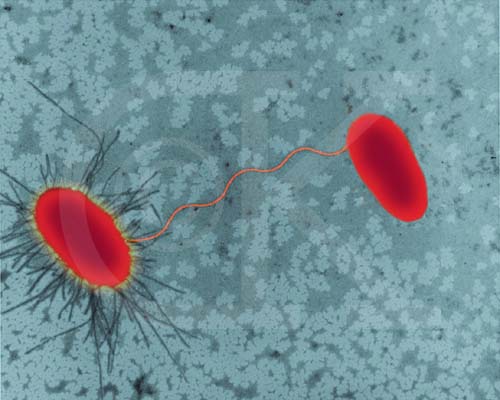 A substantial portion of the information communicated from one
single-cell organism to another is passed by transferring DNA
The image to the left shows the process of conjugation -- DNA is
being transferred directly from one bacterium to another through
the red filament in the image. Multicellular
organisms, however, exchange DNA only in the process of sexual
reproduction. This rule against multicellular genetic transfer is so
universally obeyed that
Loewenstein[1]
calls it “…the taboo of intercellular transfer of genetic
information.”
Although some intercellular information transfer is due to small ions,
e.g., Calcium and Potassium, small inorganic molecules like nitric
oxide, and by small organic molecules like glutamate, most cell-to-cell
information transfer in multicellular organisms relies on protein
messenger molecules -- none uses DNA transfer.
A substantial portion of the information communicated from one
single-cell organism to another is passed by transferring DNA
The image to the left shows the process of conjugation -- DNA is
being transferred directly from one bacterium to another through
the red filament in the image. Multicellular
organisms, however, exchange DNA only in the process of sexual
reproduction. This rule against multicellular genetic transfer is so
universally obeyed that
Loewenstein[1]
calls it “…the taboo of intercellular transfer of genetic
information.”
Although some intercellular information transfer is due to small ions,
e.g., Calcium and Potassium, small inorganic molecules like nitric
oxide, and by small organic molecules like glutamate, most cell-to-cell
information transfer in multicellular organisms relies on protein
messenger molecules -- none uses DNA transfer.
That is the state of affairs today. It seems probable that there was a lengthy transition period in the evolution from single-cell to multicellular life in which cells continued to use DNA and RNA for communication in addition to a growing dependency upon protein messenger molecules. One way or another, though, organisms that did not obey the taboo against exchange of DNA lost out in the contest of survival of the fittest.
Communication by DNA transfer
Bacterial DNA transfer is a normal and powerful means for single-cell organisms to communicate information about new ways to compete and survive in their shared chemical environment. It allows successful mutations to quickly spread to a large population of bacteria.
Direct DNA transfer is responsible for the rapid spread of antibiotic resistance among bacteria. DNA transfer does not just occur between cells of the same species. Perhaps 25% of the E. coli genome turns out to have been acquired from other bacterial species. Such cross-species gene transfer speeds the spread of new traits by a factor of 10,000[2]. If a transfer of DNA turns out to be beneficial to a single-cell organism, so much the better; it survives to pass the new DNA on to its progeny. If not, the unfortunate bacterium dies and is mourned by no one.
For multicellular organisms, safety trumps rapid evolution. We do not have to look far to understand why multicellular organisms shun DNA transfer. Importation of DNA essentially “reprograms” the cell[3]. Multicellular organisms are made up of differentiated, i.e., specialized, cells that may have completely different function from nearby cells. These differences are required for the survival of the organism. Transferring active DNA between cells would undermine differentiation in unpredictable ways. For example, a motor neuron touches many muscle cells in order to direct their contraction. Imagine the chaos if a muscle cell could inject its active DNA or active RNA transcripts that make contractile proteins, into the nerve cell. Then the nerve, rather than telling the muscle to contract, would itself contract detaching it from the muscle. Moreover, even if such DNA transfers provided potential evolutionary advantage, they would be of no value unless they could somehow make their way into the germ line (egg or sperm cells) to be passed on to progeny.
Communication by protein messenger molecules
Instead of exporting DNA, Metazoan cells export messenger molecules, primarily proteins, that bind to receptor proteins on the surface of other cells. These messenger molecules cannot reprogram the receiving cell. In fact, they cannot even guarantee a given behavioral response. A particular messenger molecule, in general, elicits different behavior in differently specialized receiving cells. Insulin, for example, is a metabolic messenger that induces very different responses in skeletal muscle cells, two kinds of fat cells, and cells in the liver. In computing terms, therefore, these messages are polymorphic; their meaning is determined by the receiving cell, not the sending cell. Because single-cell organisms are concerned with only one kind of cell (themselves), they do not need polymorphism whereas multicellular organisms cannot do without it.
Origins of multicellular messaging
Biofilms are the intermediate stage in the evolution of multicellularity, i.e., the stage between single-cell organisms and true multicellular life. They are cooperative communities of single-cell organisms each of which transfers DNA to its offspring in a single-cell manner. But cooperate with cells of their own and other species by exchanging molecular messengers. For example, “quorum sensing” bacteria both export a messenger molecule and sense its concentration in the environment. They thereby sense their population density. When there are "enough" cooperating bacteria present in a small volume, the concentration of the quorum-signalling messenger molecule becomes large enough for all of them to sense a “quorum.” They then change their gene expression behavior, for example to turn on the production of virulence factors. When acting cooperatively, their most important communication is via messenger molecules whereas, when acting as separate cells, they exploit DNA transfer via conjugation. So, when a virulent biofilm, e.g., of Staphylococcus or Salmonella is treated by antibiotics, any bacteria that happen to survive because they are more resistent to the drug are left as free single-cells that can then pass on their resistence to their progeny and to other bacteria by conjugation.
Molecular messaging in social insects
Social insects also use the polymorphic communication strategies of cells. Ants and termites, for example, communicate with others by exporting pheromones to organize the specialized behaviors of workers, fighters, male drones and even queens. Differently specialized ants respond differently to these chemical markers. That is, they respond polymorphically according to their role in the colony. It is interesting to note that this strategy goes far beyond social insects. Pheromones which, after all, are just molecular messages that are exported into the environment to be reabsorbed by others play important roles in the social behavior of many other species, including humans.
[1] See “The Touchstone of Life, Werner Loewenstein, Oxford University Press, New York, 1999 [p. 277]
[2] Science, vol. 305 no. 5682, pp. 334-335, July, 2004
[3] In the extreme case of a viral infection, it completely hijacks the cell and often kills it.
Contact: sburbeck at mindspring.com
Last revised 6/9/2012